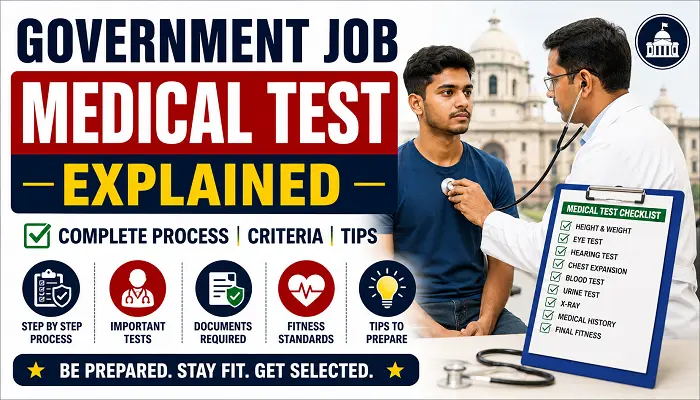
If you’ve cleared the written exam and interview for a government job, congratulations — but there’s one final hurdle left: the government job medical test. Many candidates overlook this stage, only to be caught off guard. This guide explains everything you need to know about government job medical tests — what they check, how to prepare, what disqualifies you, and what your rights are if you fail.
What Is a Government Job Medical Test?
A government job medical test (also called a medical fitness examination) is a mandatory health screening conducted before a selected candidate is officially appointed to a government position. The purpose is to ensure that the candidate is physically and mentally fit to perform the duties of the role.
Medical tests are required across virtually all government sectors — central and state civil services, police, railways, defence, banking (public sector), teaching, and more.
Why Is a Medical Test Required for Government Jobs?
Government jobs often come with:
- Long service tenures — sometimes 30+ years
- Physically or mentally demanding roles (police, army, railways, firefighting)
- Pension and healthcare liabilities — the government bears long-term health costs
- Public safety responsibilities — certain roles require full sensory or physical capacity
For these reasons, the government screens for conditions that could impair job performance or create long-term medical liability.
Which Government Jobs Require a Medical Test?
Almost all central and state government positions require some form of medical examination. The level of scrutiny varies:
| Job Category | Medical Rigor |
|---|---|
| IAS / IPS / IFS (UPSC) | Standard (Category I/II) |
| SSC (CGL, CHSL, MTS) | Standard |
| Railway (Group C & D) | Moderate to High |
| Police / Paramilitary (CRPF, BSF, CISF) | High |
| Defence (Army, Navy, Air Force) | Very High |
| Banking (SBI PO, IBPS) | Standard |
| Teaching (KVS, NVS, State PSC) | Standard |
What Does the Government Medical Test Check?
The specific tests vary by department and role, but a standard government medical examination typically includes:
1. General Physical Examination
- Height and weight (BMI check)
- Blood pressure measurement
- Pulse rate
- Temperature
- General body structure and posture
2. Eye Test (Vision Test)
One of the most critical components. Tests include:
- Visual acuity (distance and near vision, with and without glasses)
- Colour vision (using Ishihara plates — important for railways, defence, and electrical roles)
- Night vision (for defence services)
- Squint or eye muscle defects
Most departments specify minimum vision standards. For example, railway jobs often require 6/9 corrected vision in the better eye.
3. Ear, Nose, and Throat (ENT) Examination
- Hearing ability (whisper test or audiometry)
- Speech defects
- Nasal/throat obstructions
4. Chest and Respiratory Test
- Chest X-ray (to detect tuberculosis, lung infections, or other conditions)
- Lung function tests in some roles
5. Blood Tests
- Complete Blood Count (CBC)
- Blood glucose (fasting and postprandial)
- HIV test (mandatory for many central government roles)
- Liver function tests in select cases
6. Urine Analysis
- Urine routine and microscopy
- Checks for diabetes, kidney disease, or infections
7. Cardiovascular Test
- ECG (electrocardiogram) — especially for physically demanding roles
- Blood pressure assessment
8. Musculoskeletal Examination
- Joint mobility and flexibility
- Flat feet assessment (pes planus) — relevant for police and defence
- Spine and posture check
- Limb deformities
9. Mental and Neurological Assessment
- Basic neurological reflexes
- Psychiatric assessment (for sensitive roles)
- History of epilepsy or seizures
Medical Categories in Government Jobs
Different departments classify medical fitness into categories:
UPSC Civil Services (IAS/IPS):
- Category I — Fit for all services
- Category II — Fit with minor defects (certain services only)
- Category III — Unfit (can appeal via Medical Board)
Railway Medical Standards:
- A1 — Highest fitness (drivers, gatemen)
- A2, A3, B1, B2, C — Progressively lower standards for desk or administrative roles
Defence Medical Categories:
- SHAPE system (Stamina, Hearing, Apprehension, Physical capacity, Eyesight)
- Category I (P1) — Fully fit
- Category IV/V — Unfit for service
Common Reasons for Medical Rejection
The following conditions frequently lead to rejection in Government Job Medical Test:
- Colour blindness (disqualifying for many railway, defence, and technical roles)
- Poor uncorrected vision beyond the department’s threshold
- Flat feet (pes planus) — highly relevant for police and army
- HIV positive status (disqualifying for many central government roles, though this is legally contested)
- Active tuberculosis or lung disease
- Uncontrolled diabetes or hypertension
- History of epilepsy or seizures
- Significant hearing impairment
- Limb deficiency or amputation
- Chronic psychiatric conditions
- Heart disease requiring medication
Note: Having a medical condition doesn’t automatically disqualify you. The question is whether it affects your ability to perform the specific job. Always check the exact medical standards for your department.
How to Prepare for the Government Medical Test
Before the Test
- Get a pre-medical check-up at a reputable clinic 2–3 months in advance. Identify and address borderline issues (high BP, borderline sugar, anaemia).
- Control blood pressure and blood sugar through diet, exercise, and medication if needed.
- Rest well the night before — fatigue affects BP and pulse readings.
- Stay hydrated but avoid excessive fluids just before urine tests.
- Avoid alcohol and tobacco for at least 48–72 hours before the examination.
- Bring all documents: admit card, ID proof, previous medical records, and any prescription glasses or hearing aids.
At the Test
- Disclose pre-existing conditions honestly. Concealing a condition and being discovered later can lead to termination even after appointment.
- Wear comfortable clothing — you may need to remove shoes for flat foot checks or expose your chest for X-rays.
- Arrive fasting if required (typically for blood glucose tests).
What Happens If You Fail the Medical Test?
Failing a government job medical test doesn’t always mean the end of the road. Here’s what you can do:
1. Review Medical Board
Most departments allow you to appeal before a Review Medical Board (RMB). You can:
- Submit additional medical documents or specialist reports
- Request re-examination for borderline findings
- Challenge findings you believe were inaccurate
File the appeal within the timeline specified in your appointment letter (usually 30–60 days).
2. Seek a Second Opinion
If you believe the findings are incorrect (e.g., a misread X-ray or incorrect colour vision test), a documented second opinion from a government-recognized hospital can support your appeal.
3. Legal Recourse
In cases where the rejection seems arbitrary or violates disability rights (under RPWD Act 2016 in India), you may approach:
- Central Administrative Tribunal (CAT)
- High Court via a petition
Courts have, in several landmark cases, set aside medical rejections that were based on conditions unrelated to job performance.
Important Legal Provisions
- Rights of Persons with Disabilities Act (RPWD), 2016: Mandates 4% reservation for persons with benchmark disabilities in government jobs. Blanket rejections of disabled candidates without assessing functional capacity have been struck down by courts.
- DoPT Guidelines: The Department of Personnel & Training periodically updates medical standards for civil services. Check the latest circular for your cadre.
- HIV/AIDS (Prevention and Control) Act, 2017: Prohibits discrimination in employment on the basis of HIV status — though enforcement in government recruitment remains inconsistent.
Frequently Asked Questions
Can I wear spectacles during the medical test?
Yes. Corrected vision (with glasses or contact lenses) is measured. However, some roles specify minimum uncorrected vision requirements too.
Does colour blindness disqualify me from all government jobs?
No. It disqualifies you from specific roles (train drivers, pilots, electricians, certain armed forces roles) but not from desk-based or administrative government positions.
Is a tattoo a problem in government medical tests?
In the Army and police, certain tattoo placements (on the face, neck, or considered obscene/offensive) can be disqualifying. For civil service roles, tattoos are generally not a medical disqualification.
How long does the medical test take?
Typically one full day (4–8 hours), as multiple tests are conducted across different departments at the examination centre.